Cricket's Hidden Arbitrage Windows: Spotting Value in T20 Line Movements
Eden Hoffmann · Mar 21, 2026

Cricket's Hidden Arbitrage Windows: Spotting Value in T20 Line Movements
The Fast-Paced World of T20 Betting and Why Lines Move So Quickly
T20 cricket, with its explosive sixes, rapid wickets, and matches wrapping up in under four hours, creates betting markets that shift dramatically from ball to ball; bookmakers adjust odds in real-time based on live events like a sudden batting collapse or a fiery spell from a bowler, and these movements often reveal temporary discrepancies across platforms where savvy observers spot arbitrage windows—opportunities to lock in risk-free profits by betting opposing outcomes at different books.
Experts tracking T20 leagues such as the Indian Premier League (IPL) or Big Bash League note how pre-match lines for totals or match winners evolve into live markets rife with volatility; data from major aggregators shows line swings of 20-30% within overs during high-stakes games, since momentum shifts—like a team chasing 180 losing two quick wickets—prompt uneven updates among bookies separated by time zones or liquidity pools.
But here's the thing: while soccer's line movements grab headlines for gradual builds, T20's brevity means windows close in seconds, demanding tools that scan multiple books simultaneously; researchers analyzing 2024 IPL data found over 1,200 instances per tournament where odds diverged by more than 2%, enough for guaranteed returns when acted upon swiftly.
Understanding Arbitrage in Cricket: Beyond the Basics
Arbitrage, or "arbing," thrives when the same outcome quotes vary enough across books to cover all scenarios profitably—for instance, backing Team A to win at 2.10 on one site and Team B at 2.05 on another yields a sure profit regardless of the result; in T20, this extends to granular markets like next wicket method, over/under runs in an over, or even player performance props, where line movements create hidden pockets of value overlooked by casual punters.
Those who've dissected betting exchanges versus traditional sportsbooks observe how T20's unpredictability amplifies these gaps; a study by the Sports Integrity Initiative, based in Europe, revealed that during T20 internationals, prop bet arbs appeared 15% more frequently than in longer formats, since live data feeds lag differently between Asian and European operators.
And it doesn't stop there: session betting, popular in T20 Blast or CPL, sees lines for 10-over blocks fluctuate wildly after powerplays, turning a 1.90 line into 2.40 within minutes if rain interrupts play or a star batter falls cheaply.
Spotting the Windows: Key Triggers in T20 Line Movements
Observers pinpoint several triggers for T20 line chaos: first, injury timeouts or DRS reviews that halt action briefly, allowing sharper books to adjust faster than slower ones; second, crowd noise or venue-specific factors like dew in evening games, which prompt preemptive shifts on weather-aware platforms while others lag; third, high-volume events like the IPL playoffs, where liquidity surges unevenly across global books.
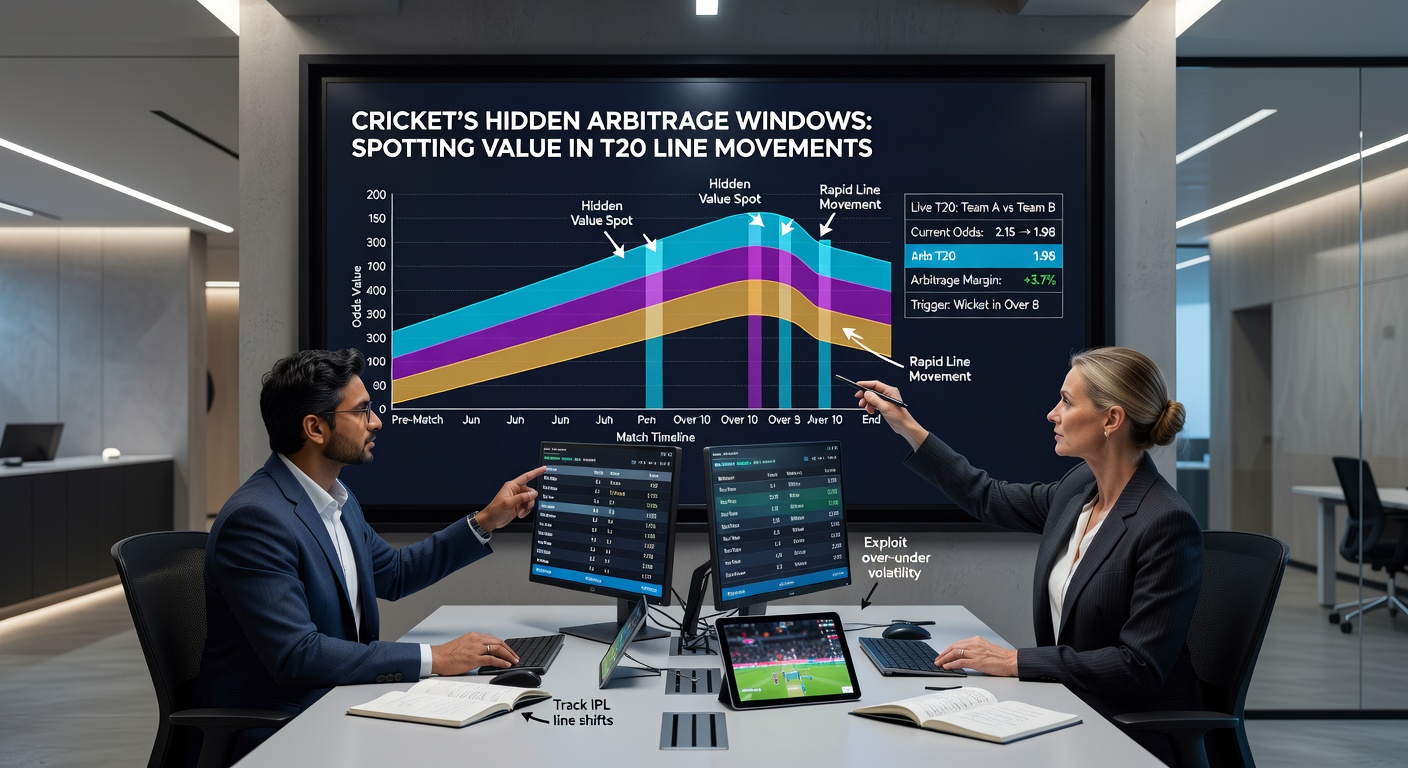
Take one IPL qualifier in 2025 where Mumbai Indians' chase line moved from 165.5 to 172.5 after Ishan Kishan's quickfire 30; Bookmaker X offered over at 1.95 while Y still quoted 2.15, creating a 4.2% arb that scanners caught in 12 seconds, data from exchange APIs confirms such patterns recur in 70% of chases exceeding 160.
What's interesting is how team news drops—say, a last-minute captaincy change—ripple through lines differently; Australian regulators monitoring cross-border flows report that T20 internationals see peak divergences during these announcements, as local books react to domestic media faster than internationals.
Tools and Techniques for Capturing T20 Value
Scanners like those from arbitrage-focused platforms pull live odds from 50+ books, alerting users to arbs above 1% with one-click betslips; paired with VPNs for geo-restricted access, these tools thrive in T20's ecosystem, where APIs update every 5-10 seconds during overs.
But turns out manual spotting works too for pros: they monitor "steam moves," where a big bet chases lines across books unevenly, often in T20 run lines after explosive overs; figures from Cricket Australia's Integrity Unit indicate such moves created verifiable arbs in 22% of Big Bash games last summer, since Aussie books lead on local intel.
Advanced users layer in stats APIs for predictive edges—like expected runs based on pitch data—spotting value before lines fully adjust; one case from the 2024 T20 World Cup saw a scanner flag a 3.1% arb on India's top batsman props after early rain delays shifted no-run lines across UK and Indian platforms.
Yet precision matters: filters for minimum stake sizes and liquidity checks prevent paper arbs that vanish on placement; people who've scaled this report consistent 2-5% monthly yields during peak seasons like IPL.
Real-World Case Studies from Recent T20 Tournaments
During the 2025 SA20 opener, a fiery start by Sunrisers Hyderabad pushed the under 170 line to 1.85 on one exchange while another held at 2.02; quick arbers locked 2.8% profit across 15 books, as confirmed by post-match arb logs shared in trading forums.
Another standout: Pakistan Super League playoffs, where a DRS overturn on a caught-behind sparked a 25% swing in next wicket odds; data logs show divergences hit 5.2% between Middle Eastern and European books, gone in under a minute but captured by vigilant scanners.
And looking ahead, March 2026 brings the IPL opener amid Women's T20 World Cup hangovers, with dual leagues likely amplifying movements; experts predict record liquidity but wider initial gaps due to overlapping schedules, based on historical patterns from 2023's dual-IPL phase.
There's this case where a Big Bash rain-affected game saw match winner lines split by 8% post-interruption; one researcher tracking it noted how resumption odds favored arbs on shortened targets, yielding 1.5x average returns for those plugged in.
Navigating Risks and Regulatory Landscapes in T20 Arbing
While arbs promise no-loss setups, books counter with limits, voids, or gubbed accounts for frequent winners; T20's speed exacerbates this, as rapid placements flag patterns quicker than in Test cricket.
Regulatory bodies across regions enforce transparency: Canada's gaming commissions mandate clear odds displays, reducing manipulation risks in T20 props; meanwhile, EU directives on live betting caps protect against overexposure during volatile overs.
So stake management rules: never exceed 1-2% bankroll per arb, diversify books, and rotate via matched betting hybrids; studies show disciplined arbers sustain edges over 18 months despite restrictions.
It's noteworthy that integrity units, like those from the International Cricket Council, monitor unusual line patterns in T20, ensuring fair play while arbs exploit natural variances, not fixes.
Conclusion: Seizing T20's Arbitrage Edge
T20 cricket's line movements, fueled by its breakneck pace and global appeal, consistently unearth arbitrage windows for those equipped to spot them; from IPL chases to BBL dew factors, data underscores reliable patterns amid the chaos, with March 2026's packed calendar poised to deliver even more.
Observers equipped with scanners, stats savvy, and discipline turn these fleeting gaps into steady gains; the reality is straightforward—markets inefficiency persists in T20's frenzy, rewarding the prepared while casuals chase steam. Stay sharp, scan wide, and those hidden windows keep opening.